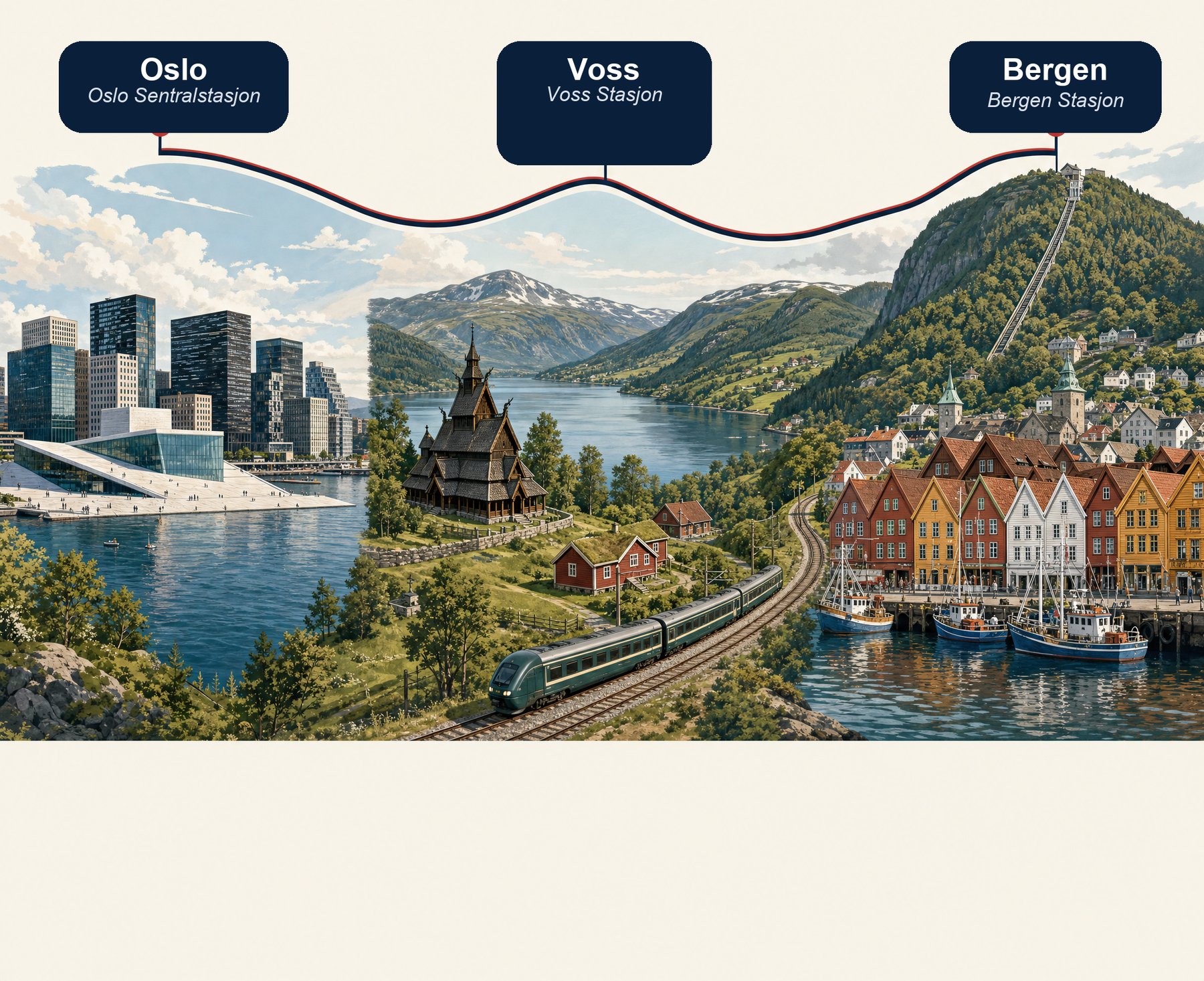
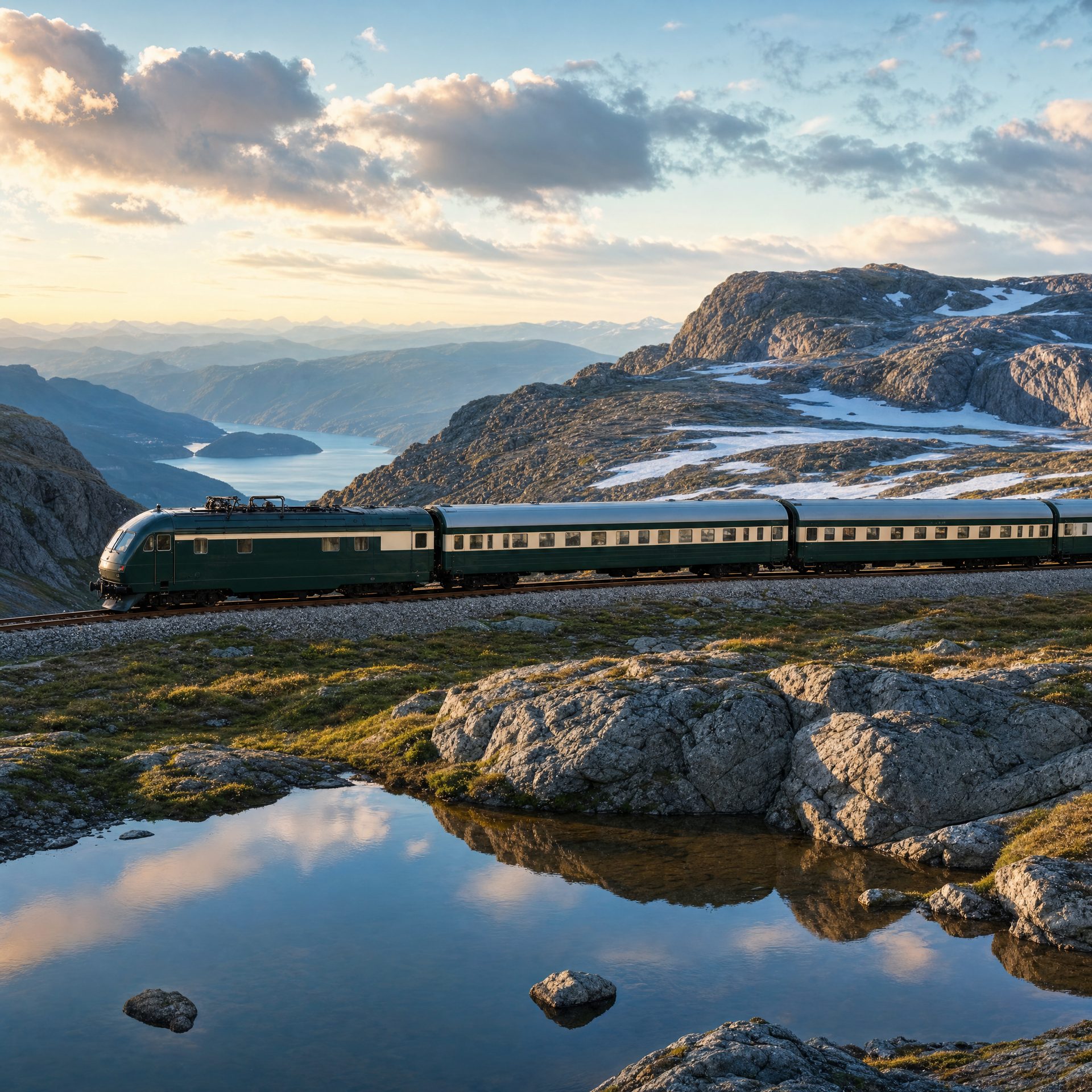
496 km of track climb from the Oslo fjord to 1,237 metres of arctic tundra at Finse — the highest mainline railway in Northern Europe — before dropping back to sea level in Bergen. No road follows it this faithfully, and no flight shows you any of it.
All three routes exist because Norway's geography makes each one a real trade-off. Timetables sometimes list the return leg simply as Bergen Oslo, no preposition needed — here's how they compare either direction, door to door.
Centre to centre, no airport transfer, and the only way to actually see Hardangervidda.
Cheap flights exist on this route, but both airports sit well outside their city centres, and Bergen's weather doesn't always cooperate.
Freedom to stop anywhere in your own rental car — but winter storms can shut the route entirely.
Vy's Oslo to Bergen train follows the Bergensbanen — literally the Bergen Railway — opened in 1909 and still the highest mainline railway in Northern Europe. From Oslo Central Station (Oslo S) it climbs steadily for roughly three hours to Finse, at 1,222 metres the highest station on the network, before the line tops out at 1,237 metres inside the Finse Tunnel and begins its long descent into Western Norway and the fjords around Bergen. The full Oslo to Bergen journey is a seven-hour journey door to door on the slower services, and this Norwegian train is routinely ranked among the most scenic train journeys — some say the single most scenic train ride — in Europe.
Change at Myrdal and take the Flåm Railway (Flåmsbana): the train descends 866 metres to the fjord village of Flåm in about an hour — one of the steepest standard-gauge railways on earth, built by hand between 1923 and 1940, with 20 tunnels along just 20 km of track. It runs on the same Vy network as the Bergensbanen, so it's a same-ticket-system add-on, not a separate booking.
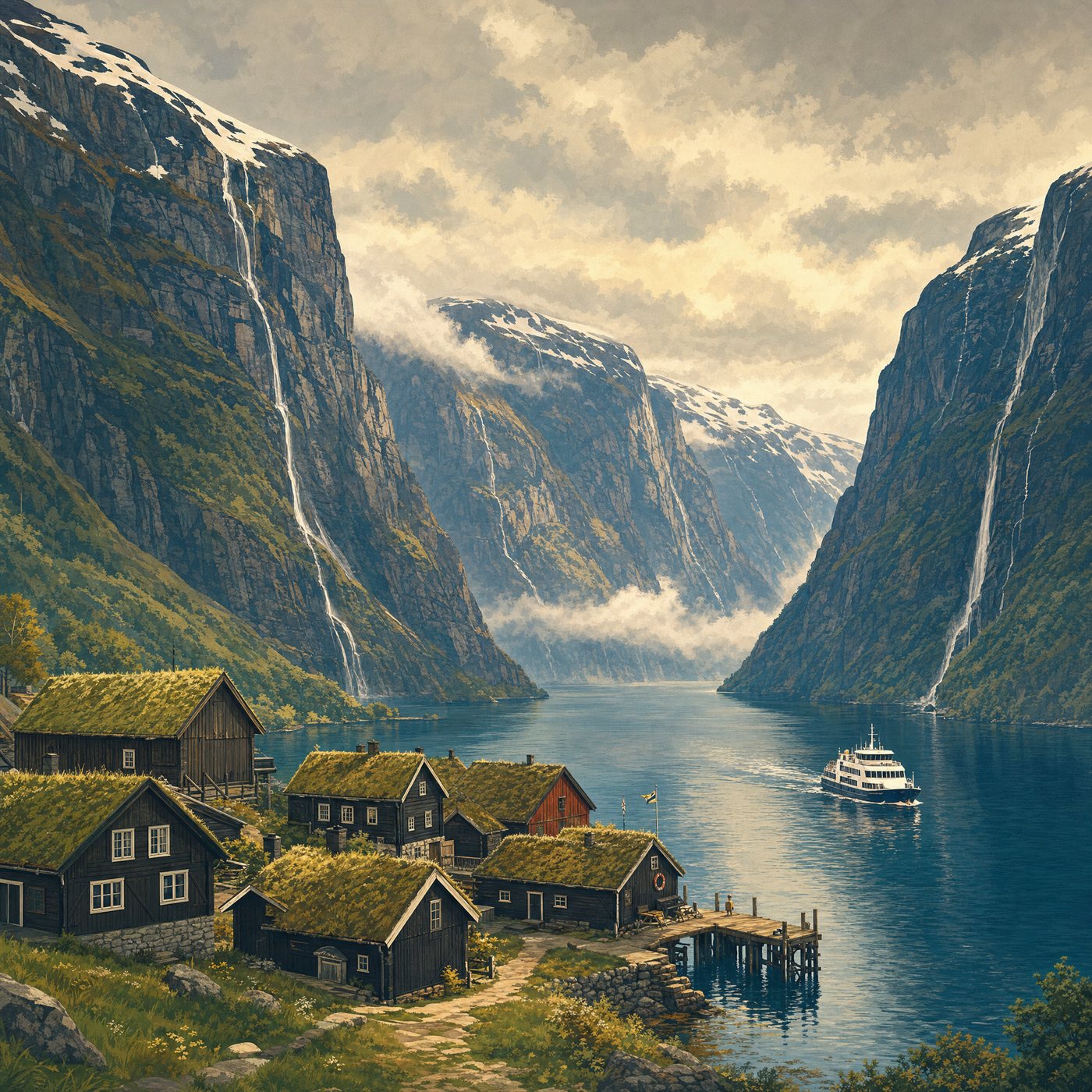
Many travellers extend the ride into a full round trip sold commercially as "Norway in a Nutshell": the Bergensbanen to Myrdal, the Flåm Railway down to the fjord, a fjord cruise on the UNESCO-listed Nærøyfjord past tiny fjord villages like Gudvangen, then a bus back up to Voss to rejoin the main line. Fjord Tours markets the packaged version, but every leg — including the fjord cruise — can be booked separately, and the train legs are usually cheaper bought directly than through a nutshell tour or a reseller like Rail Ninja.
Most travellers do the full loop in a single long day, since the Bergensbanen, the Flåm Railway and the fjord cruise all run on a coordinated timetable with little idle waiting between legs. It's an early start either way — but it turns one train ride into a genuine tour of the fjords, on top of the Bergensbanen's own scenery.
Every Flåm Railway train stops for about five minutes at Kjosfossen waterfall. In the summer season, a dancer dressed as Huldra — a seductive forest spirit from Norwegian folklore — appears at the base of the falls, performs, and vanishes as the train pulls away. It's one of the strangest, most memorable five minutes on any railway in Europe.
The performance draws on centuries-old Norwegian folk tales, in which Huldra lures travellers into the forest with her singing — a nod to the waterfall's own roar drowning everything else out. It's included at every scheduled stop, so it's worth having a camera ready as the train slows into Kjosfossen.
Watch the fjord and mountains roll by, then search fares for the journey.
Search trains →Scroll to follow the train from the Oslo fjord up to 1,222 metres at Finse and back down to Bergen — the colour shifts from fjord green to arctic white and back, tracking elevation, not distance.
Central departure point, a five-minute walk from the Oslo fjord and the Opera House.
1,222 m, no road access at all — everyone and everything arrives by train.
Steps from Bryggen's wharf and the fish market, back at sea level among the fjords.
In 2009, NRK filmed the entire Bergensbanen journey, uncut, to mark the line's 100th birthday — and accidentally invented a TV genre.
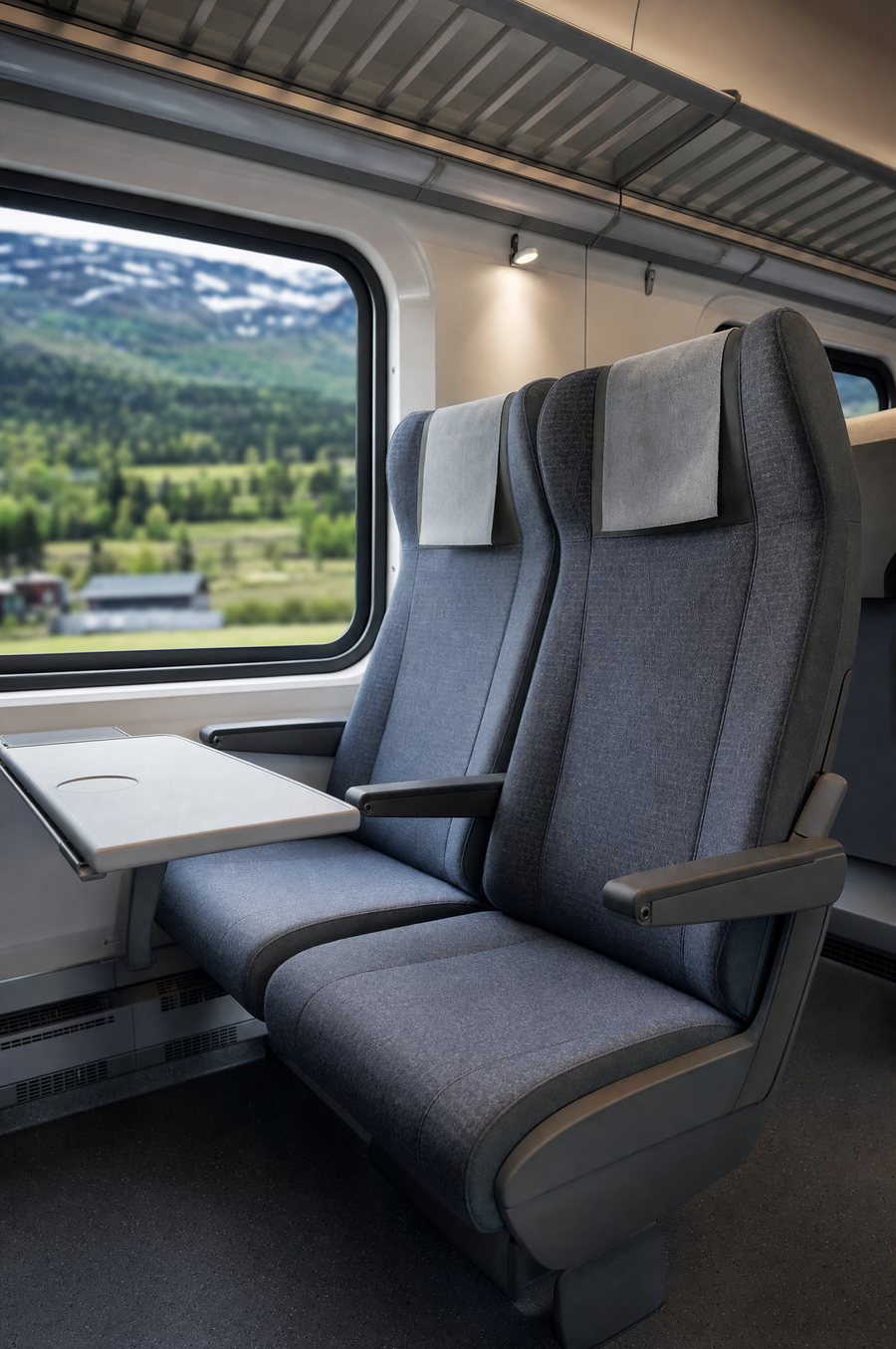
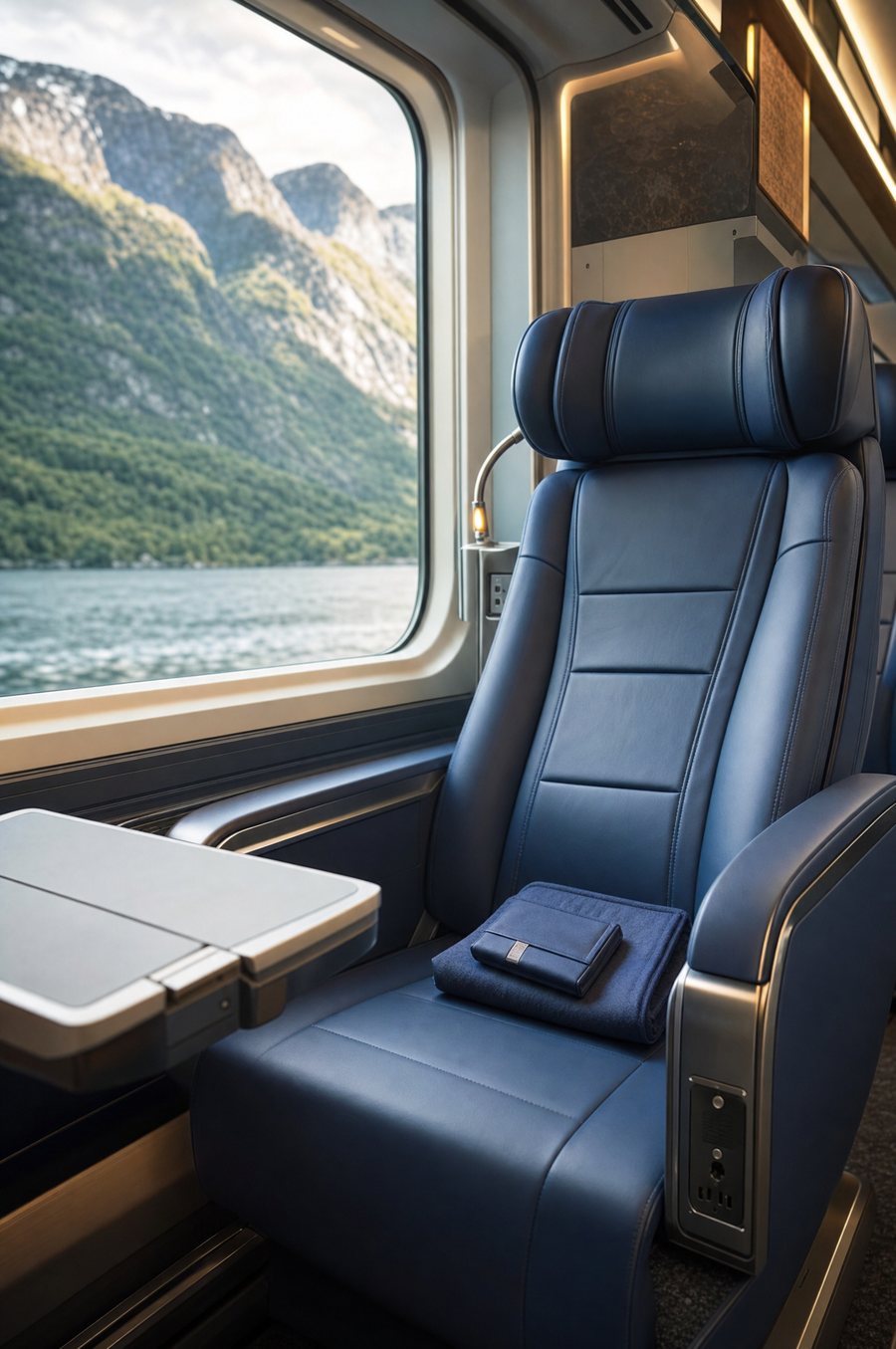
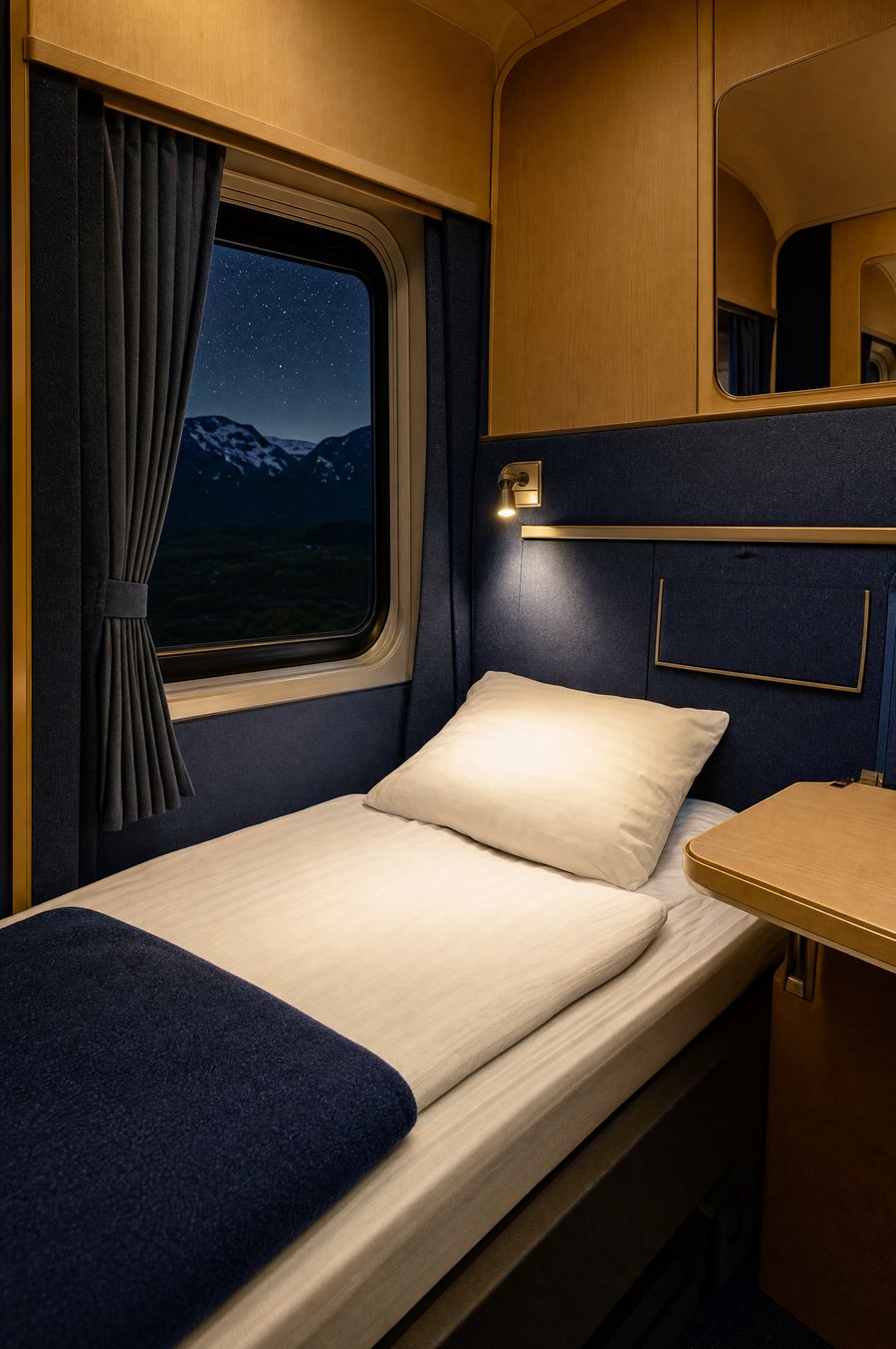
Vy runs comfortable day services with two seat classes, plus an overnight PlusNight train for travellers who'd rather sleep through the transit than watch it.
The base fare class on every day train — 2+2 seating with a fold-down table and power socket at every seat, plus free Wi-Fi the length of the journey.
Vy's answer to first class — the same 2+2 layout with wider seats, extra legroom and a quieter carriage.
The sleeper service — board in the evening and wake up as the train rolls into Oslo or Bergen.
A few notes on Oslo, Bergen, and the stops worth breaking the journey for — not a full guidebook, just what's actually worth your time.
Vy typically releases discounted advance fares around 90 days out, and prices climb as each train fills.
Even in midsummer, 1,222 m of arctic tundra at Finse can bring snow while the rest of the ride is mild.
Unlike a one-coast route, Bergensbanen's best views swap sides constantly across the plateau.
Same ticket network, no extra transfer stress — just change trains on the same platform.
Long stretches of Hardangervidda have patchy or no mobile signal — load maps, music and shows before you board.
PlusNight gets you there while you sleep, without losing a travel day to the journey.
Vy's fastest direct Bergensbanen trains cover the 496 km in around 6 hours 45 minutes. Most day trains take between 6h45 and 7h20 depending on stops, and the overnight service takes a little over 7 hours on its slower schedule.
496 km by rail. 371 km of that is the historic Bergen Line proper between Hønefoss and Bergen, with the rest running from Oslo S to Hønefoss on the Randsfjord and Drammen lines.
The track peaks at 1,237 metres above sea level inside the Finse Tunnel, a few minutes past Finse Station — itself the highest mainline railway station in Northern Europe at 1,222 metres.
Trains depart from Oslo S (Oslo Sentralstasjon) in the city centre and arrive at Bergen stasjon, a short walk from the harbour and the old Bryggen wharf.
Yes — Vy's PlusNight service runs overnight with private sleeper compartments alongside regular seats, covering the whole route while you sleep. Many travellers also break the journey with overnight stays in Voss or Flåm rather than riding straight through.
The Flåm Railway (Flåmsbana) branches off at Myrdal and drops 866 metres to the fjord village of Flåm in about an hour — one of the steepest standard-gauge railways in the world, with a scenery stop at Kjosfossen waterfall. It runs on the same Vy network, so it's an easy add-on to the Bergensbanen.
Yes. In 2009, to mark the line's 100th anniversary, Norwegian broadcaster NRK aired "Bergensbanen minutt for minutt" — all 7 hours and 16 minutes of the journey, uncut. Around 1.2 million Norwegians watched, and it kickstarted the global Slow TV genre.
There isn't one consistent scenic side — some travellers say the left-hand side gives slightly better plateau views heading toward Bergen, but Bergensbanen curves through valleys and across the plateau, swapping the best views from left side to right. Any window seat is worth it; just be ready around Finse and the descent toward Voss and the fjords.
Flying is fastest in the air at around 50 minutes, but both airports sit outside their city centres and delays from wind or fog aren't unusual at Bergen. Driving the E16 takes roughly 7 to 8 hours and crosses mountain passes that can close in winter storms. City-centre to city-centre, and running in nearly any weather, the train is usually the least stressful option.
Vy typically releases discounted Minipris advance fares around 90 days before departure, and prices rise as each train fills up — booking as early as your plans allow gets the lowest price.
Compare live Oslo–Bergen fares for this legendary train ride in one search, then book directly with our booking partner.
Search trains now